★7/5/2012
Tuesday, 8 May 2012 • 06:59 • 0 comments
On the last Thursday, i went for Seminar for Gender Confusion Disorder in IIUM Kuantan. To summarize, we learn disphorbia, cross-dress, transgender, genetical factor, counseling challenges in dealing with this issues and many others. I had a great interest in the talk and had much unanswered question in my mind. It is rather complicated to deal with ethics in counseling when it clashes with our ethics for religion.
Accidentally, our last cross-cultural class were been talking about the same thing. As for being a counselor, we have to help our client for coming out. that is to make decision as to them are right. Not to the counselor. What may be right to us as a counselor, might be wrong for the client. It is not our right to decide for them.
However, counselor SHOULD NOT impose value but we are allowed to expose value. This is a great dilemma for a Muslim counselor. As a Muslim counselor, we are answerable to Allah and not to any human being or organization. Our action would be question and thus we shall decide for the best of our religion.
It is better to have a different gender confusion client to counsel rather than client with the same religion of us. Having input from them, we can make them decide for the best of their religion interest. We as a counselor would not be judgmental, discriminant and biases. Moreover, every religion had their own guideline in handling gender confusion disorder among their believers.
For further information, you can read on 'Guidelines for Psychotherapy with Lesbian, Gay and Bisexual Clients' (Division 44/ Committee on Leesbian, Gay and Bisexual Conderns, 2000)
Labels: Journal
★mission of education : prepare students for life
Monday, 7 May 2012 • 08:15 • 0 comments
- need for management skills - growth, differentaiation and use of resources to meet need
- development of skills, including social, cognitive, emotional, psychological and ethical competencies
- development of person's worth, sense of competence and personal wellbeing
there are two types of school
academic curriculum
- where the teachers focus on syllabus too much
- focus on exam
- use text book
- cannot take student out from class to have counselling session
- guide by counselor
# take note that it is more important about what is right and wrong rather than syllabus
# this problem ( focusing on syllabus) maybe come from ministry of education
# however, counselors hold the key for resolution
why cross-cultural career
- increasing diversity in society and in the workforce
- different factors affecting career development of diverse students racism and economic
- advantage/ disadvantage choosing poor schooling, non-stimulating environment, lack of role models and etc
my point of view
- the most important things to teach students is not only stated in textbook and syllabus but it also involves the application the life. the most obvious weakness that majority of Malaysian students always face is that, we are making a student who is ready for examination rather than prepare students to enter for living a life. this is what make Malaysia education system is lacking.
from Dila

Labels: Journal
★Multicultural Issues/ Diversity in Assessment
Tuesday, 24 April 2012 • 20:22 • 0 comments
Monday 23/04/2012
- counselors use with caution assessment techniques that were normed on populations other than that of the client
- counselors recognize the effects of age, colour, dissability, ethinic grup and etc
- counselors should protect the rights of client in testing. Some of the rights are:
- informed choice
- the possibility of using test in decision making
- right to ask questions about the test
- right to refuse/withdraw consent at any time
- etc
- is needed for client consent
- results must be accompanied by accurate interpretation
multicultural career counselling
- unique background and experiences of culturally different students
- increasingly multicultural/multi ethnic society
- by 2020, a majority of school children in USA will be ethnic minorities
- problem with current model
- values inherent in counselling often clash with or are mismatched with those of the culturally diverse students
- culturally different studies still face many barriers in career development
- need for change
- career services should address the unique needs of culturally different students
- some career information is infused in the curriculum
- but most of the textbook are based on majority culture and most teachers do not have multicultural awareness
my point of view
from my own perspectives, I believe that some people may agree with me but some are not. for me, I think that multicultural issues that happen nowadays happened because in school we are lacking in stressing the importance of respecting other cultures.
teachers always said that we should always respect each other regardless of their race, language, skin color and so on. however, how many teachers really practice it. teachers just following the syllabus in textbook. even so, the text book does not provide a detail information about other cultures besides Malay, Chinese, Indian, Kadazan, and etc, however, what about India-Muslim, Jakun, Jawa, Minang and etc..
so, I think teacher should play important roles by giving extra information about other cultures that are not familiar with students.
from, Dila

Labels: Journal
★16/4/2012
• 19:04 • 0 comments
On 16th April 2012, we have learned about how to deal client with different culture in counseling. Our lecturer gave us a situation or case for us to think what kind of assessment that suitable to the client at current. A situation that our lecturer gave us is about:
“A married client (female), who wants to have a night class, came to seek counseling with a Malay counselor. The client had opposite culture with the counselor. The client’s problem began when her husband did not allowed her to take night class and this led her to stress. They already had children. No matter what she did, the husband still did not allowed her to take night class. The client had tried to involve suicide as she is stress with the current problem in her life. The counselor had suggested her to have divorce. So if we at the counselor situation, what we should do to deal with the client who has opposite culture? ”
Our lecturer asked all students to find the suitable assessment for the client and the reason why we chose the assessment. Our group’s answer is using the Reality system/model which is want, direction and doing, evaluation, planning and action (WDEP). Our reason is because the model can help the client to explore her wants, needs, and perceptions in her life. All wants may relate to the basic needs (power, love and belonging, survival, freedom, fun). Next, the process of direction and doing is when they will discuss about the overall direction of her life. For example, what she is doing? Where their behavior is taking her?. Then, at evaluation stage, the client will evaluate her current behavior such as “Is your current behavior bringing you closer to people important to you?”. At final stage which is planning and action, the client is encouraged to formulate an action that is suitable with her level of commitment so that she is willing to work to bring about change.
Overall, the reality therapy focuses on the current behavior and it is suitable for the client to have better improvement with current behavior. We also had suggested that to deal with the client, we need to take cultural consideration as the client had opposite culture with the counselor. There must be reasons why her husband did not allowed her to take night class in their culture. We also want the client to think what other alternative that she can do if she wants to take the class. In our opinion, there are different class that the client can choose whether in morning or night.
After the discussion, our lecturer had provided guidelines or answers to deal with the client. The first important thing that we should do is we must give the client an assessment. This assessment may be given one or more than one to see the seriousness of client’s current state. The assessments that our lecturer suggested are:
1) Clinical interview
2) Standardized test
3) Behavioral observational
4) Mental status examinations
5) Information from significant others
6) Analysis of case records
7) Genograms
8) Drawings
9) Journal/ autobiographical writing
10) Decision-making test
The guidelines provided by the lecturer can help us to assess the client well. Hope, we can use the assessments when dealing with the same situation so that we will not encounter any difficulties in future. Good luck guys! :)
Labels: Journal
★RACIAL CULTURAL IDENTITY DEVELOPMENT MODEL
• 08:45 • 0 comments
In previous Cross Cultural class, we are lucky as we have an opportunity to learn about Racial Cultural Identity Model (RCID). RCID is a good framework for understanding culturally different clients. Do you know what is RCID? Below, we will elaborate it briefly. Hopefully, you will have a clear picture on what is RCID. Actually, there are five stages of development. They are comformity, dissonance, resistance and immersion, introspection, and integrative awareness.
Comformity
- similar to cross's pre encounter
Dissonance
- imcompatibility between what one learns from teachers and peers and the realities in society.
Resistance and Immersion
- one endorses minority - held views and rejects the dominant values of majority. Later on, it will lead to a sense of guilt and anger.
Introspection
- one discovers that hatred for dominant culture psychologically draining, feels uncomfortable with extremist views, and tries to create a balance.
Integrative Awareness
- an individual acquires an inner sense of security. he or she can appreciate positive aspects of own culture and positive aspects of dominant and other cultures. The person may have strong commitment to social justice and strives to eliminate all forms of oppression.
RCID Model is important in helping counselor to avoid stereotyping client and be aware of differences in their attitudes, beliefs, and behaviors. Also, it can predict drop out, early termination and reaction to counseling process. Furthermore, it helps to acknowledge socio political influences on identity-history of discrimination, marginalization, and oppression.
Hopefully, you will gain some new knowledge from our information. Lets appreciate other cultures as we live in a one roof.. ONE MALAYSIA!
Hopefully, you will gain some new knowledge from our information. Lets appreciate other cultures as we live in a one roof.. ONE MALAYSIA!
Labels: Journal
★9/4/2012
Thursday, 12 April 2012 • 09:16 • 0 comments


Before, we have learn on the violence in school that involves different races and how to tackle it. In this class, we learn on how to assess on issues of multicultural as a counselor. Sir Siraje tells us on B.A.S.I.C.I.D. To look at the letters itself have made me full of excitement. I was always a big fan of letters association / formula. So here is what it stands for:
Behavior
Affect
Sensation
Imagery
Cognition
Interpersonal
Drugs
As a counselor (not necessarily only), we need to observe on the behaviors (body language, movement), the mood / emotion, the body senses, the visual imagery of the client ( like dreams), how they think (the cause & effect, short-tern & long-term memory), people around them and their physical health. For a counselor, a special emphasize need to be taken on the Affect that include the client's mood or emotion.
Be it assessing, testing or observing the issues. The crucial point is on the resolution strategies that one should take and implement. I would like to quote Sir Siraje words on debrifing that I think would conclude this all.
' We can go to find fault and punish. Or we can make it into learning experience.'
Very true indeed. If we want to make it into a mistake, than a mistake it is. But if we choose not to, than we can get so much more. A reason to be better. Okay. Till next time..^^
Labels: Journal
★2/4/2012
• 08:59 • 0 comments

Racial / Cultural Identity Development (RCID) model offers us to better understand culturally different client (as for counselor). It consist of 5 stages include:
1) Conformity
2) Dissonance
3) Resistance & Immersion
4) Introspection
5) Integrative Awareness
So, our class were discussing on how to stop violence of different races using RCID model. Here are some of the main points or tips for counselor ( or counselor-to-be):
a) We use RCID model to avoid stereotyping
b) We can better understand the uniqueness that exist around us
c) We can see it from different framework
- As an outreach ( we can educate the family, school member etc)
- As an advocate ( to speak on behalf of student or minority)
- As a liaison
- As a consultant
- Or as a change agent ( to change culture of school)
Okay. Thats all for now. Feel free to comment or sharing things you learn to. See ya..^^
Labels: Journal
★APPRECIATIVE INQUIRY
Wednesday, 4 April 2012 • 23:53 • 0 comments

The picture above shows the approach to Appreciative Inquiry. It is the ‘4-D’ model:
- Discover—people talk to one another, often via structured interviews, to discover the times when the organisation is at its best. These stories are told as richly as possible.
- Dream—the dream phase is often run as a large group conference where people are encouraged to envision the organisation as if the peak moments discovered in the ‘discover’ phase were the norm rather than exceptional.
- Design—a small team is empowered to go away and design ways of creating the organisation dreamed in the conference(s).
- Destiny—the final phase is to implement the changes.
This approach can be applied to various situation and settings, so does to multicultural counseling. We just ned to adjust it to our needs and surrounding.
Labels: Journal
★14/3/2012
Tuesday, 20 March 2012 • 06:40 • 0 comments
Malaysia, Religious Oriented? or Secularism?
I believe that we are religious oriented. Just look around us. There are mosque, temple, Thaipusam, Aidilfitri, Chinese New Year celebrated everywhere. Having said so, I did NOT look at it negatively. Malaysia is made up of different races, religion, language etc. Believe it or not, the only way to differentiate this differences is only through our religion orientation. It is such a shame to admit that and yet I am Malaysian. But that is true indeed. I truly love Islam yet I love being Malaysian.
Labels: Journal
★29/2/2012
Wednesday, 7 March 2012 • 07:29 • 0 comments
The very class we get this assignment. Please anticipate our journal of classes and outdoors activities..^^

Short Clip
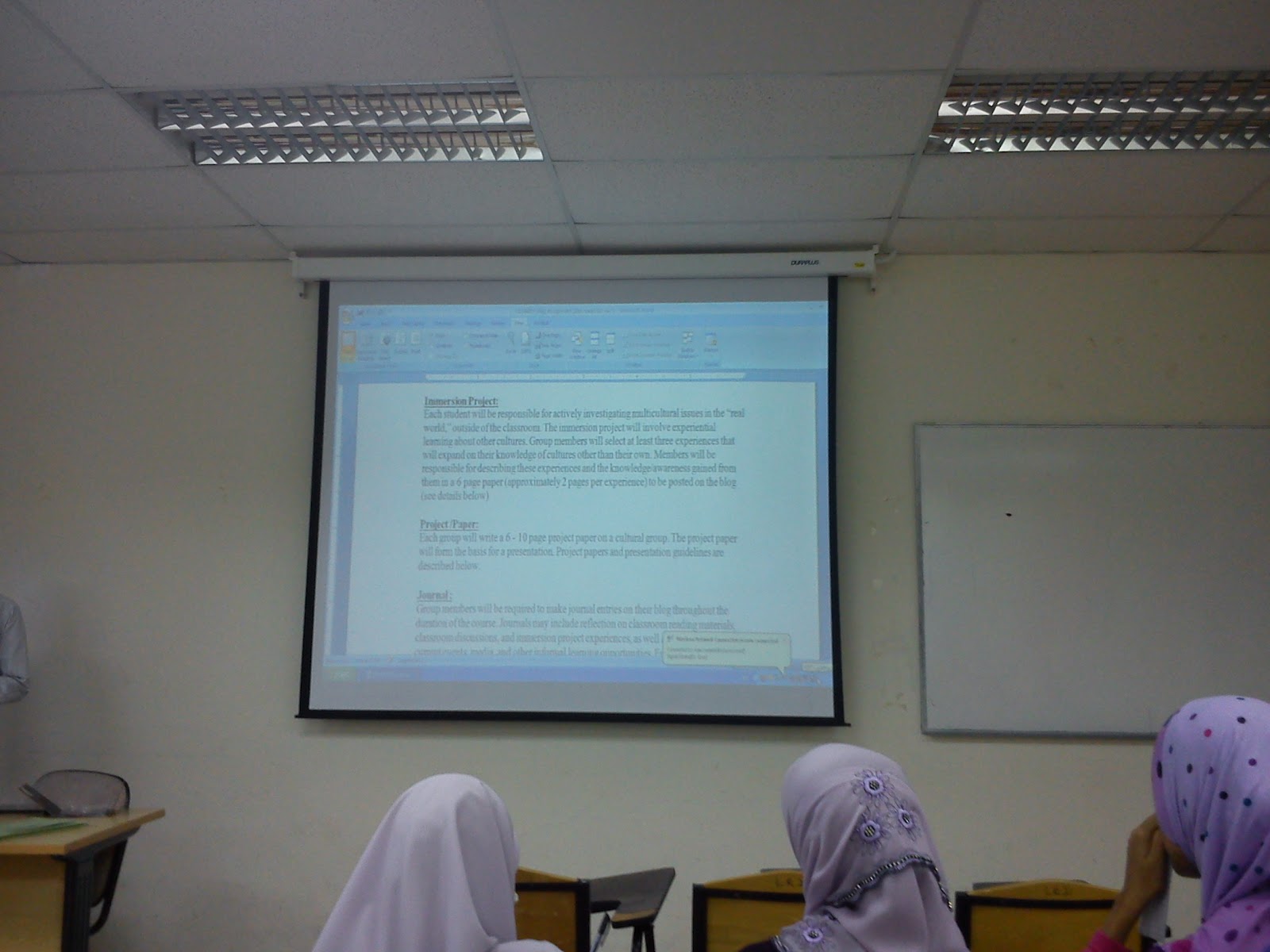
Lecture

The CD
p/s: did not expect the client would commit suicide. but I guess that is how the world work.
Labels: Journal
Love The Culture In You
★Welcome!

Follow // Dashboard
You don't have to burn books to destroy a culture. Just get people to stop reading them. By Ray Bradbury.